If you’re an equine business owner on the East Coast, you don’t need me to tell you how brutal this winter has been.
Two bomb cyclones in less than a month. Winter Storm Gianna in late January/early February dumped up to 17 inches of snow across the Carolinas—their heaviest snowstorm in decades. Then the Blizzard of 2026 hit in late February, burying the Northeast under 1-3 feet of snow with hurricane-force winds that knocked out power to over 650,000 people.
Barns were buried. Lessons were canceled for weeks. Clients couldn’t—or wouldn’t—drive to your facility. Your horses stood in stalls while you hemorrhaged money on shavings, hay, and hazard pay for staff willing to muck in blizzard conditions.
And here’s what nobody talks about: while you were in survival mode, potential clients were sitting at home with nothing to do but plan for spring.
They were researching trainers for when the weather breaks. Comparing boarding facilities for their horse’s summer home. Looking for clinics to attend once arenas thaw. Making decisions about who to work with—all from their couch, while the snow piled up outside.
The question is: were they finding you?
How People Search When They’re Snowed In
During both bomb cyclones, I watched something fascinating happen. While barn owners were focused on keeping horses safe and operations running, riders and horse owners were doing what everyone does when they’re stuck inside: scrolling, researching, planning.
But they weren’t typing “horse trainer near me” into Google and clicking through ten different websites to compare options.
They were asking ChatGPT: “I need a dressage trainer within 30 miles of Boston who has an indoor arena and works with adult amateurs. Who should I contact?”

They were using Perplexity to ask: “What are the best boarding facilities in central Massachusetts with daily turnout and quality hay programs?”
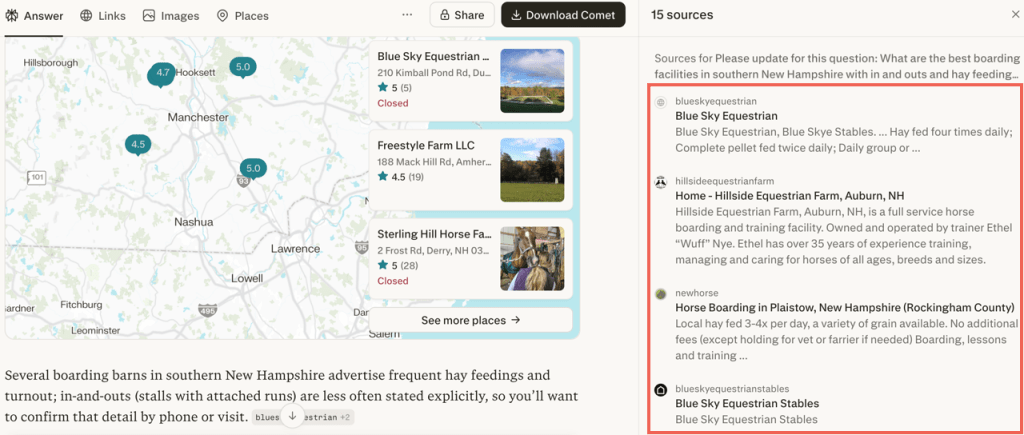
They were getting answers from Google’s AI Overviews without ever visiting a website.
And if your business wasn’t optimized for AI search, you weren’t part of those answers—even if you’re the perfect fit for what they’re looking for.
What Traditional SEO Misses (And Why It Cost You Spring Bookings)
Here’s the uncomfortable truth: traditional SEO optimizes your website to rank on Google search results pages. You want to be in the top 10 when someone searches for your services.
But AI search doesn’t work that way.
When someone asks ChatGPT or Perplexity for recommendations, these AI engines:
- Pull information from across the entire web (not just the top 10 Google results)
- Synthesize multiple sources into a single, direct answer
- Often give recommendations without the person ever clicking on a website
- Prioritize businesses with clear, structured, authoritative information that’s easy to parse
If your equine business has:
- An outdated website with vague descriptions like “premier equestrian facility”
- No Google Business Profile (or an incomplete one with three photos from 2019)
- Thin content that doesn’t demonstrate specific expertise
- No presence on industry directories, local listings, or equine community sites
…then AI engines either don’t know you exist, or they don’t have enough confidence in the information to recommend you.
While you were breaking ice and moving hay during the blizzard, your competitors with strong GEO (Generative Engine Optimization) were getting inquiries from riders planning their spring training schedule.
Those bookings you’re hoping for in March and April? Someone else already got them—in February, while you were digging out.
The Hidden Cost of Being Invisible to AI
Let me paint a specific picture of how this plays out.
A rider in Connecticut is snowed in during the February blizzard. She’s been thinking about finding a new trainer for months—someone who specializes in eventing and can help her move up to Prelim. She’s got nothing but time, so she opens ChatGPT and asks:
“I’m looking for an eventing trainer within 45 minutes of Hartford, CT. I’m currently riding Training level and want to move up to Prelim. I need someone with experience bringing horses up through the levels who also teaches adults. Can you recommend anyone?”
ChatGPT scans the web. It finds:
Trainer A: Has a detailed website clearly stating “Eventing training from beginner through Advanced. 15+ years experience bringing horses up through the levels. Adult amateur specialists. Located in Farmington, CT. Students have competed successfully through Advanced level.”
Trainer B: Has a website that says “Premier equestrian training facility. We offer lessons and training in a beautiful setting. Contact us to learn more!”
Guess who gets recommended?
Trainer B might be just as qualified—maybe even better. But AI can’t tell because the information isn’t there. The website is vague. There are no specifics about disciplines, experience level, student results, or what makes them qualified.
So the rider contacts Trainer A. Books an evaluation ride for April. Commits to a training program. All decided in February, while sitting on her couch during a snowstorm.
Trainer B never even knew they were in the running.
GEO: Making Your Expertise Visible to AI
GEO (Generative Engine Optimization) isn’t about gaming AI or tricking algorithms. It’s about presenting your expertise clearly enough that AI can understand it, trust it, and recommend you.
Here’s what that looks like for equine businesses:
1. Replace Vague Marketing Speak with Specific Details
AI engines can’t work with generic descriptions. They need concrete information.
Instead of: “We provide world-class training in a state-of-the-art facility designed for the discerning equestrian.”
Write: “Hunter/jumper training barn in Aiken, SC, specializing in AA-rated show preparation. 25 stall facility with two outdoor rings (one grass, one sand), 12 acres of turnout, and a dedicated tack room for boarders. Head trainer has 20+ years experience and students regularly qualify for Devon, Lake Placid, and WEF.”
See the difference? The second version gives AI (and humans) everything they need to know: discipline, location, level of competition, facilities, trainer experience, and proof of results.
2. Show Your Expertise in Ways AI Recognizes
AI engines look for authority signals. For equine businesses, that means:
Credentials matter:
- USDF certifications and medal achievements
- Competition records (yours or your students’)
- Judging or clinician experience
- Association memberships (USEF, USEA, AQHA, etc.)
Content proves you know your stuff:
- Blog posts answering questions riders actually ask
- Case studies showing how you’ve helped specific horses/riders progress
- Videos demonstrating your training methods
- Client testimonials with specific results
If someone asks AI “How do I know if a trainer is qualified?” and your website has zero proof—no credentials, no student results, no educational content—AI won’t recommend you over someone who clearly demonstrates expertise.
3. Be Everywhere AI Searches
AI doesn’t just look at your website. It pulls information from across the entire web and synthesizes it.
That means you need consistent, accurate information on:
Industry directories:
- USEF
- USDF
- USEA
- Breed-specific registries
- FEI (if applicable)
Local business listings:
- Google Business Profile (complete with photos, services, hours, reviews)
- Facebook Business Page
- Yelp
- Local chamber of commerce or tourism sites
Equine community sites:
- Chronicle of the Horse forums (showing up in answers to questions, participating in discussions)
- Local barn directories
- Show results databases
- Clinic and event listings
Every mention of your business—every listing, every review, every show result, every social media post—adds to the information AI has available when someone asks for recommendations in your area.
4. Answer Questions Before They’re Asked
AI search is conversational. According to usage analyses from Similarweb, OpenAI documentation, and multiple conversational AI studies published on arXiv, most productive AI sessions involve several follow-up prompts and typically last between six and twelve minutes.
Riders ask questions like:
- “What should I look for in a boarding facility if my horse is on stall rest?”
- “How do I find a trainer who can help with a spooky OTTB?”
- “What’s the difference between a natural horsemanship approach and classical training?”
- “How much should I budget for full board in [my area]?”
If your website or blog answers these questions thoroughly, AI can pull from your content when generating responses. You become the authoritative source—even if the person never clicks through to your site.
This is why educational content matters more than ever. It’s not just about SEO anymore; it’s about being the answer AI chooses to share.
What the Blizzards Revealed About the Future
Winter 2026 accelerated a trend that’s been building: the shift from search engines to AI assistants.
Younger riders—the clients you need to attract for long-term business growth—grew up with AI. They expect instant, personalized recommendations. They’re not going to spend an hour researching websites when they can ask ChatGPT for the answer in 30 seconds.
But it’s not just Gen Z. More than ever I see seasoned horse owners in their 50s and 60s start using AI search (they’re big fans of the speech-to-text feature) for the first time because it was easier than trying to navigate clunky barn websites on their phones.
Once people experience the convenience of asking AI a question and getting a curated answer, they don’t go back to the old way of searching.
Your Competitors Are Already Figuring This Out
While you were focused on managing the blizzard aftermath (entirely reasonable), some of your competitors were also thinking about the future.
They were:
- Updating their websites with clear, specific information AI can parse
- Optimizing their Google Business Profiles with current photos and detailed service descriptions
- Creating content that answers the questions riders ask
- Building their presence across industry directories and local listings
When spring hits, and riders start reaching out to book training, lessons, and clinics, who do you think AI will recommend?
The barn with detailed information, demonstrated expertise, consistent online presence, and authoritative mentions across the web?
Or the barn with an outdated website, vague descriptions, and a Google Business Profile that hasn’t been touched since 2020?
How to Get Started With GEO (Without Overwhelming Yourself)
I know you’re exhausted. You just survived two bomb cyclones, you’re probably still catching up on barn work (thanks to the spring thaw), and the last thing you want is another complicated marketing project.
The good news: you don’t have to do everything at once. Start with what matters most:
This Week: Fix Your Google Business Profile
- Log in and complete every single field
- Add 10-15 current photos (barn, arenas, horses, you working with clients)
- Write a detailed business description with specifics: disciplines, services, experience, facilities
- List all services you offer (boarding, training, lessons, clinics, etc.)
- Post a weekly update (even if it’s just “Spring training slots now available”)
Next Week: Clarify Your Website Homepage Rewrite your homepage to answer these questions clearly:
- What do you offer? (Be specific: hunter/jumper lessons, dressage training, full board, etc.)
- Who do you work with? (Beginners? Adult amateurs? Young riders? Specific disciplines?)
- Where are you located and what’s your service area?
- What makes you qualified? (Experience, credentials, student results)
- What are your facilities? (Number of stalls, arena sizes, turnout, amenities)
Week 3: Create One Piece of Educational Content Write a blog post answering a question you get asked frequently:
- “What should I look for in a boarding facility?”
- “How do I choose the right trainer for my discipline?”
- “What’s included in full board vs. partial board?”
This doesn’t have to be long. 500-800 words of genuinely helpful information is better than 2,000 words of fluff.
Week 4: Get Listed on Industry Directories if you’re not already there
- Claim your USEF or USDF profile (if applicable)
- Get listed on breed association directories
- Join your local equestrian organization and get listed in their directory
- Make sure your information is consistent everywhere (same business name, address, phone)
Ongoing: Build Momentum
- One blog post per month answering a common question
- Weekly Google Business Profile updates
- Respond to reviews (positive and negative)
- Share show results, student achievements, clinic announcements
It could be just 30-60 minutes per week of focused effort that compounds over time. But if that still feels like too much to juggle, Contact me, and we can discuss service plans to meet your GEO needs.
Why This Matters Now More Than Ever
The equine industry is at a turning point. The way people find trainers, boarding facilities, farriers, and vets is fundamentally changing.
Traditional word-of-mouth still matters. Local reputation still matters. But if you’re not visible in AI search, you’re cutting yourself off from a huge—and growing—segment of potential clients.
And here’s the kicker: the businesses that adapt early get a massive advantage. Right now, most equine businesses have terrible online presence. If you fix yours while everyone else is still winging it, you dominate.
Six months from now, when AI search is even more mainstream? It’ll be harder to stand out. The businesses that started building their GEO strategy now will already have the authority, the content, and the online presence that makes AI recommend them first.
The Bottom Line
Winter 2026 was brutal. Two bomb cyclones, weeks of canceled lessons, mountains of unexpected expenses.
But it also revealed an uncomfortable truth: the future arrived while you were digging out.
Riders spent those snow days researching trainers on ChatGPT. Horse owners compared boarding facilities using AI. Parents planned their kids’ summer riding programs by asking Perplexity for recommendations.
The businesses that got those inquiries—the ones that will see their spring and summer schedules fill up—weren’t necessarily the best trainers or the nicest facilities.
They were the ones AI could find, understand, and recommend with confidence.
The snow has melted. Spring is here. Riders are ready to get back in the saddle.
When they ask AI for help finding the right trainer, boarding facility, or equine professional, will your business be part of the answer?
Want help building a GEO strategy that future-proofs your equine business? Contact me for a consultation. After 10+ years in the equine industry and hands-on experience implementing GEO at the world’s leading animal health company, I know exactly what works for equine businesses—and what’s a waste of your time.
 Cathleen Voss Consulting
Leave a comment